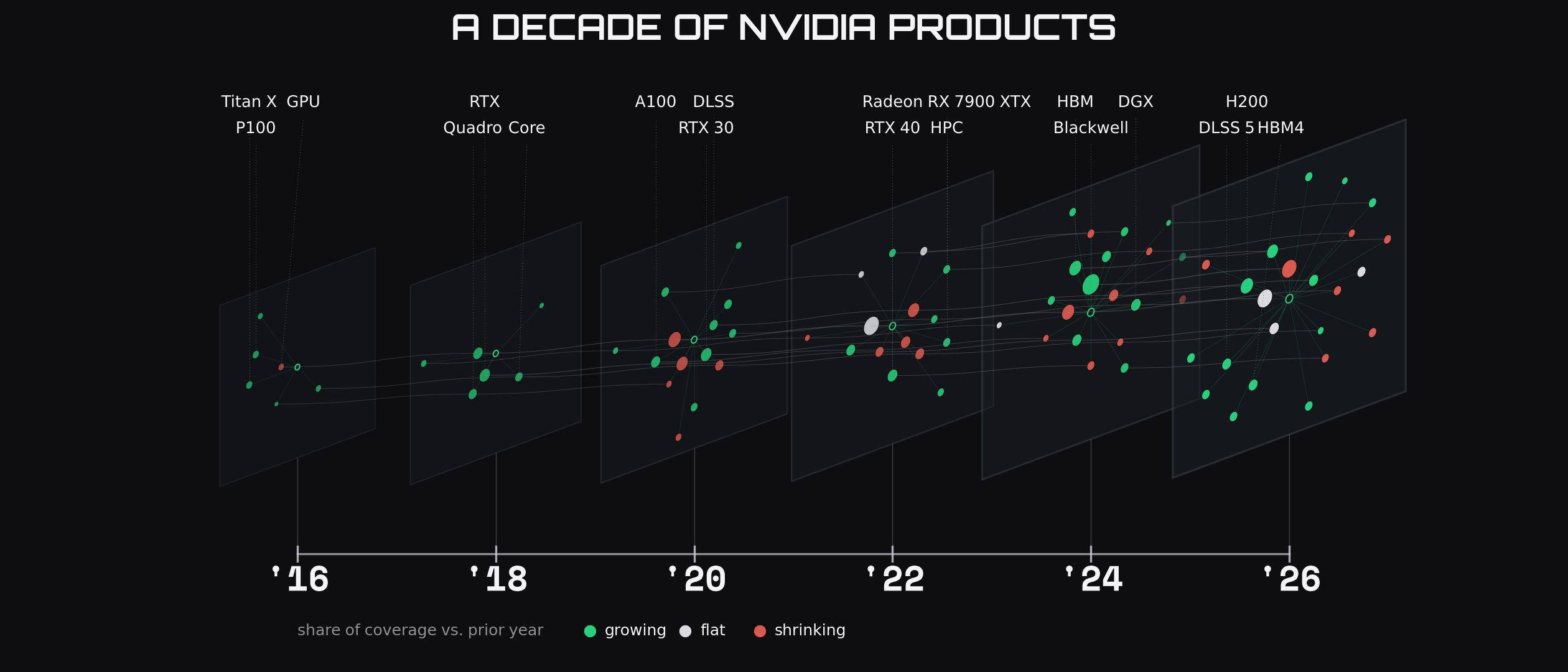
Companies change: people leave, products die, mergers happen. This post shows how to build point-in-time knowledge graphs over any company from news alone, using NOSIBLE World, which covers 38 thousand tickers, 3.2 million organizations and 6.4 million people. Named entity recognition supplies the nodes, lift-scored co-mention supplies the links, and the document date keeps every yearly view safe to backtest.
2026-07-168 min read
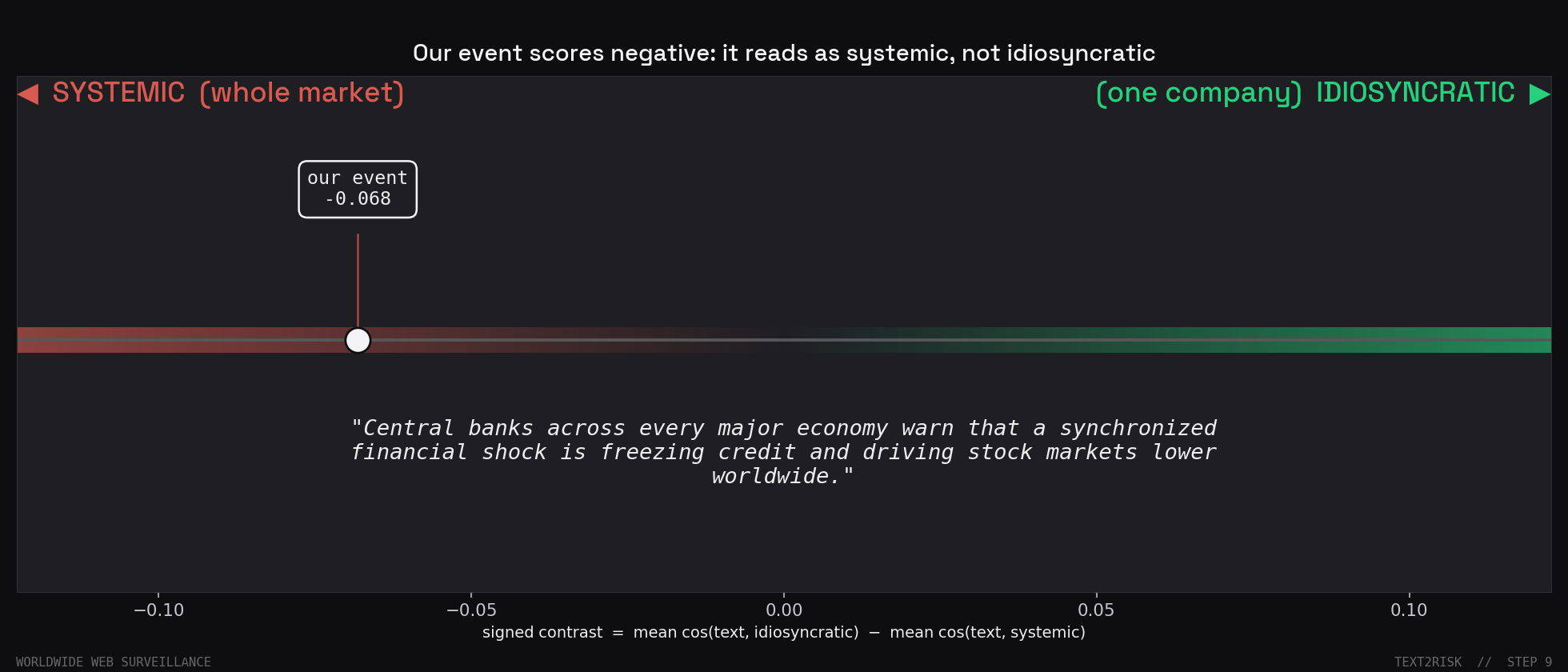
A ten-step, training-free walkthrough that turns a frozen OpenAI text embedding into clean classifications: a multiclass relevance score sorts events into local, national, and global buckets, and a contrastive binary score splits systemic from idiosyncratic risk. Verified on real warnings from NOSIBLE World, the geometry matches Google's gemini-2.5-flash while staying deterministic, auditable, and effectively free.
2026-06-1814 min read
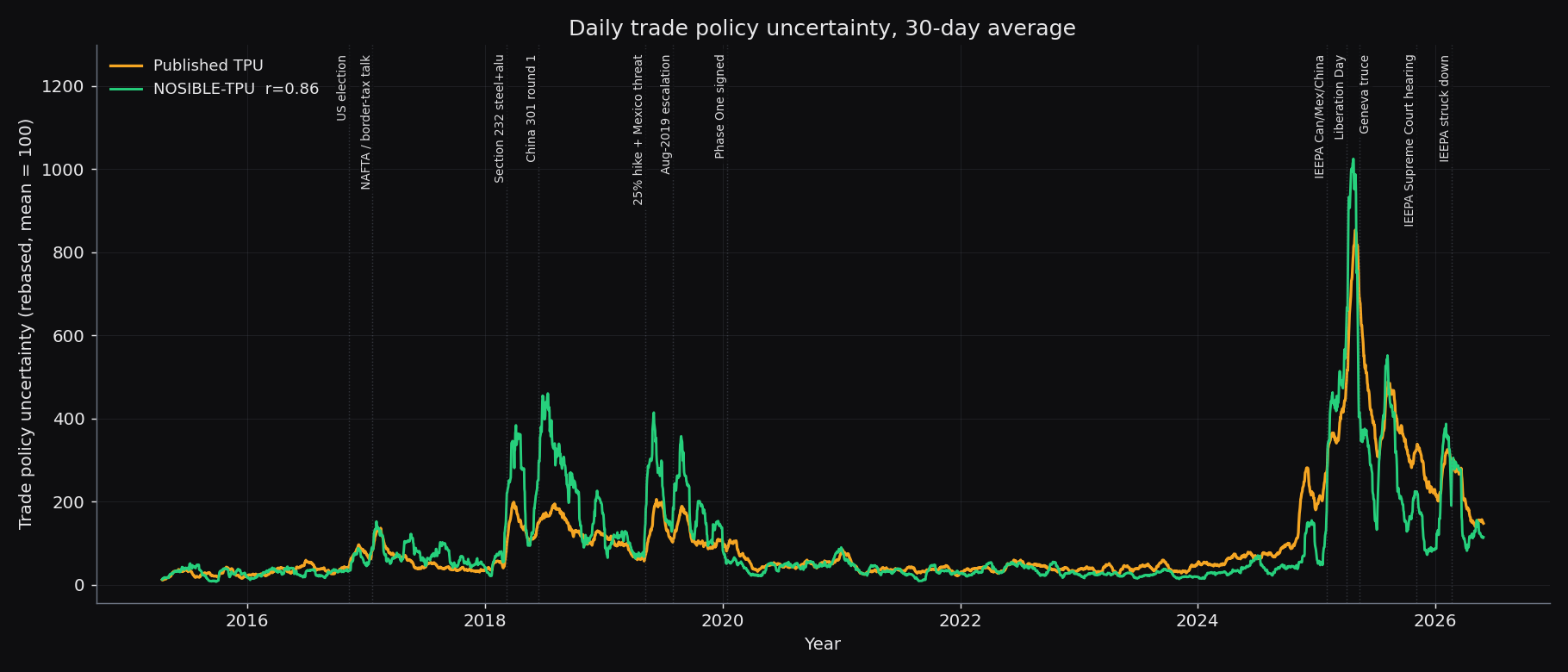
The Fed's Trade Policy Uncertainty index counts keywords across seven newspapers. We rebuilt it from 14.9 million NOSIBLE World events using only embeddings and five sentences, no keywords. It matches the published benchmark at 0.87 on monthly levels and 0.82 on monthly changes, as closely as the two official versions match each other. The same method, extended to sixty sentences, rebuilds the broader Economic Policy Uncertainty index and its national-security and healthcare categories.
2026-06-1723 min read
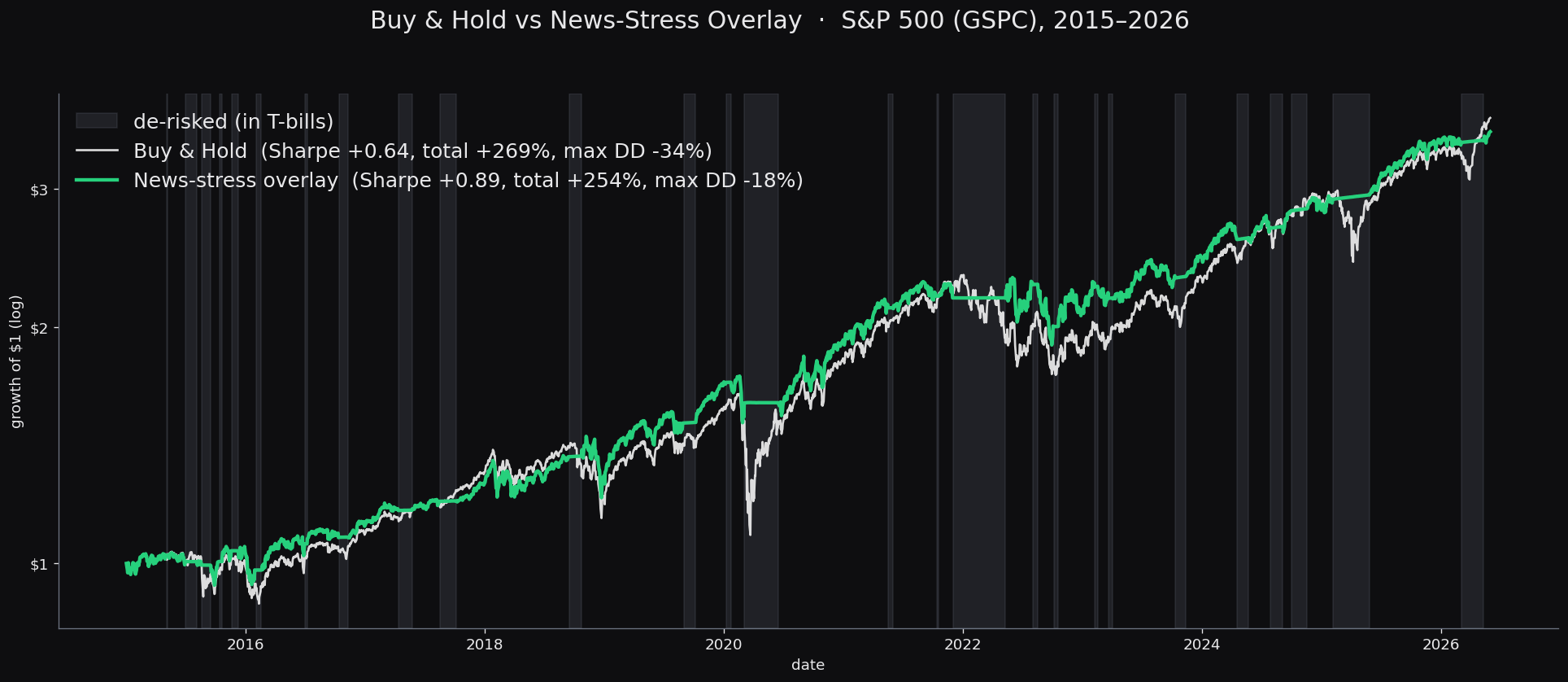
We built a risk-on/risk-off trading signal from the NOSIBLE event database that measures how much of the global news flow is about market-stress themes, holding equities when that reading is low and moving to T-bills when it spikes. Selected on 2010 to 2013 and tested on an untouched 2015 to 2026 window, it held the S&P 500's buy-and-hold return (+254% versus +269%) while cutting the maximum drawdown from −34% to −18% and raising the Sharpe ratio from 0.64 to 0.89. The same rule transfers unchanged to the Nasdaq and the Russell 2000.
2026-06-169 min read
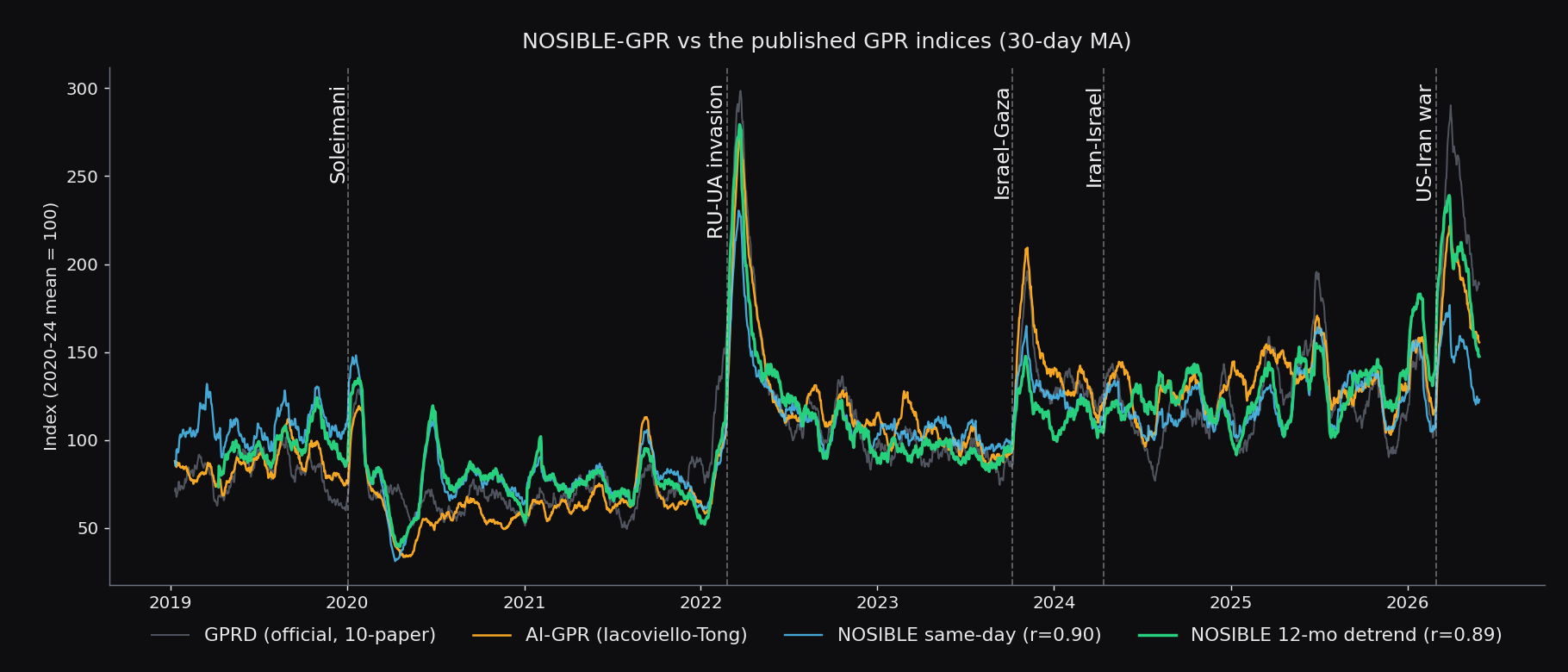
Markets move on geopolitics, but risk models cannot read the news. We turned 13.2 million news events into a geopolitical risk signal, matched the Federal Reserve benchmark, and broke it down by country, by country pair, and into an oil supply-risk signal.
2026-06-0615 min read